
Dormant Pruning - Part 2
by Dan Eskelson on Apr 30, 2012

Please also visit, Part 1 - The Art and Science of Pruning
Visualization is an extremely important skill that will help in your pruning efforts. For this reason, I've created some simple line drawings and uploaded them within this article
Pruning cuts must be made with full knowledge of future consequences, relying on our perception, or visualization, of the plant's growth characteristics, intended use, age, and desired form. Various plant forms are "created," early in the plant's life, by choosing new growth which will eventually produce the desired shape. The growth that does not conform to our visualization is removed.
For example, the vase, or open center, tree relies on a short, strong vertical trunk to support several main leaders, which in turn supports numerous "laterals." Choose leaders which emerge from the trunk at approximately a 10 o'clock or 2 o'clock angle; these will provide the strength necessary to hold future growth, snow and ice loads and the crop. Leaders must be spaced evenly around the trunk.
 As leaders enlarge over the years, choose the laterals which directly hold foliage, flowers and/or fruit. By visualizing the mature form and understanding growth habits, proper spacing of laterals is achieved. For instance, an apple needs room to mature with plenty of light and air, but this vigorously growing tree continually sends out excess growth which will stunt the development of fruit (as well as limiting total plant health).
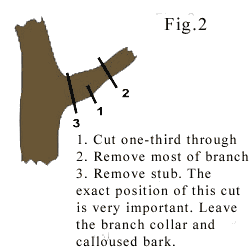
With regular pruning, saw cuts are seldom necessary - but if they are, *take great caution*. In Fig. 2 notice that the final cut is slightly outside the trunk line and angled down and outward. This ensures that the trunk's sap flow will produce the healing tissue which will eventually seal the cut. Many trees have been lost or seriously deformed by the improper saw cuts. Don *not* use tree paint or any other sealer on pruning cuts. If you are not sure of your technique, call a professional.
The most common error of amateur pruners is leaving "stubs." When heading back, always cut just above a bud - or just above lateral growth. When thinning entire branches, cut back to the source growth. See Fig. 3. Stubs invite rot - *Do not leave stubs!*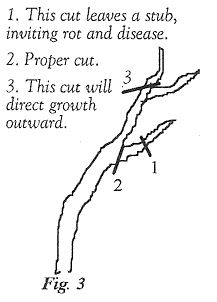
Vigorously growing plants produce "suckers," rapidly growing, usually vertical, shoots. Cut these yearly, or they will restrict air and light from the middle of the plant and eventually become dominant over properly positioned growth. One exception to this rule is when reworking older trees or shrubs, a well placed sucker may be chosen to replace a branch too horizontal or otherwise inferior. After one season's growth, cut this sucker back to an outside bud, removing 1/3 to 1/2 of its length.
Care must be taken when pruning old, overgrown trees. A thorough job completed in one season will seriously weaken, or possibly even kill the tree - spread this renovation pruning over three years to limit shock to the tree.
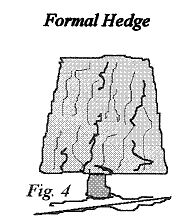 When pruning hedge plants, be sure to angle the sides slightly outward from top to bottom; otherwise, lower portions of the plant will not receive enough light, will become thin, and eventually leave bare areas - see Fig. 4.
To summarize briefly - remember to visualize the ideal form of the plant and make each cut contribute to that form. Remove diseased, dead or damaged wood and remove branches which cross (or those which you see *will* cross or otherwise conflict). In general, favor growth which grows outward overgrowth which grows back toward the middle of the plant.
*Always* use a sharp pruning, and *never* leave stubs. This basic discussion of the art and science of pruning will get you off to a good start, but before going out to prune the whole yard, gather additional information from a good book and/or lessons from an experienced pruner.
Popular Articles
Three Places to Spend Money on the Exterior of Your Home
When you have the exterior of your home remodeled, you are investing, time, energy and convenience into the project and you want to make sure that...
107701 Views
Homemade Headboards-Make an Upholstered or Wooden Headboard
Homemade headboards can add a lot of personality to any bedroom. They can be coordinated with existing furniture and room decor or they can be the...
81108 Views
When to Use a Brush, Roller or Sponge Brush
Brushes are a good choice for painting trim and woodwork. They are also useful for cutting in the edges around the top and bottom edges and corners...
73660 Views
Creating a Cottage Kitchen with Bead Board
Kitchen decor can range from modern and bold to elegant and elaborate by using strategic kitchen pieces. One of the most popular decorating trends...
59479 Views
Gas Fireplace Diagnostics and Troubleshooting
Follow these steps for diagnosing and troubleshooting Gas Fireplaces repairs. For the average DIYer, this may seem intimidating, depending on the...
36395 Views
Latest Articles
Signs You Need Professional Plumbing Repair: Don’t Ignore These Warning Signs
Ignoring the signs of a pending plumbing disaster can lead to significant damage and costly repairs. For instance, homeowners might not realize...
on Jan 20, 2026
Beneath the Surface: Why Professional Trenchless Sewer Line Repair
Beneath the Surface: Why Professional Trenchless Sewer Line Repair is Essential for Modern Homeowners
on Jan 14, 2026
Hydro Jetting Services: Unclog Your Pipes with the Power of Water
When faced with stubborn clogs and slow drains, conventional solutions often fall short. But with the innovation of hydro jetting services,...
on Dec 15, 2025
Why Professional Heat Pump Installation is Key to Maximizing Efficiency and Longevity
Heat pumps are a highly efficient means of heating and cooling homes, reducing energy costs and contributing to environmental sustainability. To...
on Dec 15, 2025
Why Professional Boiler Repair is Essential for Home Safety and Comfort
Maintaining a warm and safe home environment is paramount for any homeowner. Your home's boiler system plays a critical role in this, but what...
on Nov 5, 2025
Featured Articles
What Type of Licensed Contractor Should You Hire?
on Feb 28, 2017
Hire Contractors / Estimates

Looking for a specialty project? There are many types of contractors available for your home improvement needs. Finding the right type of...
Actions
Top Categories
- Garden / Landscaping / Patio — 264
- Kitchen / Bathrooms — 240
- Real Estate / Finance — 203
- Appliance / Repair — 186
- Interior Design / Decor — 184
- HVAC / Air Conditioning — 150
- Cleaning / Maintenance — 144
- Improvements / Remodeling — 131
- Plumbing / Basements — 121
- Floors / Tile / Hardwood — 116
- Safety / Security — 114
- Doors / Garages — 113
Articles Archive
More DIY Articles
Understanding the Waste Electrical and Electronic Equipment Directive
The Waste Electrical and Electronic (WEEE) Directive is a set of guidelines from the European community that dictates how electrical goods and...
How to Make a House Feel More Homey
Moving into a new house comes with many needs. One of the most important is making that house a home. But where should you start? Your main concern...
Finding the Electric Range that is Right for You
When you first start to look for an electric range it may seem overwhelming, but if you break it down into a few simple steps it becomes easy and...
6 Easy Tips to Sell Your House Fast
If you’re in the market to sell your house, you might find yourself constantly overwhelmed and stressed about this project. Selling a house is no...
5 Home Improvement Tips for Aging in Place
Are you getting older, but do not want to move out of the comfort of your own home? Well, no one can blame you- staying in the house you are...